





VENICE 2026 Venice Production Bridge
Venice and Eurimages figures show gender gains, but entrenched gaps remain across European film
- VENICE 2026: Fresh data point to growing female participation across parts of the industry, while directing, technical roles and higher-budget projects remain far from balanced
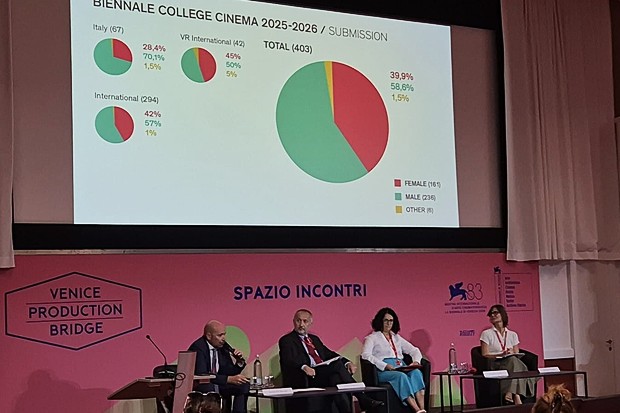
The changing position of women across European cinema came under scrutiny on 8 September at the Hotel Excelsior’s Spazio Incontri, where La Biennale di Venezia and Eurimages presented their latest figures during the Annual Seminar on Gender Equality and Inclusivity in the Film Industry, held as part of the Venice Production Bridge (3-9 September).
Andrea Del Mercato, general manager of La Biennale di Venezia, described the organisation’s annual monitoring exercise as an attempt to provide “a real-time photograph” of the film industry gathered around the festival. Rather than treating the statistics as an end in themselves, he said the material should serve as “food for thought, information” and debate, as well as a work resource available to the wider professional community.
At the institutional level, Del Mercato noted that the Biennale’s management is evenly divided between men and women, while the festival’s juries this year showed an overall female majority. The picture becomes substantially less balanced, however, when it comes to the films submitted for selection.
Out of the 2,103 feature films submitted, circa 25% were directed by women. That figure rose to nearly 39% amongst the 2,649 submitted short films. Del Mercato highlighted this recurring difference between formats, pointing out that female participation tends to drop as projects become larger and more demanding financially. The figures for first and second features were somewhat more encouraging, with the proportion of female filmmakers rising amongst directors at an earlier stage of their careers. “Perhaps something in the system is evolving,” he suggested.
Once submissions became selections, the disparities remained significant. According to the figures presented, women directed only 9% of all Competition titles while their representation rises to circa 40% in the Orizzonti sidebar and the short-film selection has reached an even 50/50 split. Venice Immersive stands at approximately 29%. Looking at the figures across the period extending from 2020 to 2026, Del Mercato nevertheless stressed that the broad picture remains one of relative stability rather than dramatic transformation, with shorts consistently proving more accessible to female directors.
Biennale College Cinema offered another useful indicator. Twelve projects were selected for the latest edition, with four due to move into production through grants of €200,000 each. The programme, now in its 15th edition, has generated 49 films through its main production scheme and according to Del Mercato’s estimations, roughly 75 micro-budget works developed within the wider College ecosystem have eventually reached screens, including projects which were able to get financing through other channels.
The picture presented by the pool of film professionals attending Venice is even more encouraging. Del Mercato said that across the different categories of accredited participants, genders are evenly split and in some cases, a female majority emerges. The contrast between film professionals and filmmakers is quite striking: women appear to be strongly represented amongst the professionals circulating around the festival and its industry activities whereas when it comes to authorship and production and especially directing, their presence remains much weaker.
Enrico Vannucci, deputy executive director of Eurimages, then took the floor to widen the scope to European co-production. After reminding the people present in the room that the fund began formally working on gender equality in 2013, before the issue acquired its current level of institutional prominence, and highlighting the Council of Europe’s 2017 recommendation on gender equality in the audiovisual sector as a significant milestone, he pointed out the fact that Eurimages had since then broadened this strategy to encompass diversity and inclusion alongside gender.
Compared to the industry benchmark for female presence, estimated at roughly 26%, Vannucci revealed that Eurimages’ own pool of eligible projects had gradually shifted from a 70/30 male-female split, more or less, to one closer to 60/40. However, aggregate figures do conceal striking differences between professions: women are significantly better represented in certain creative roles than in some technical departments, where the imbalance remains especially steep.
When it comes to directing, there are nevertheless clear signs of progress. Across the past decade, the share of female directors as recorded by Eurimages has risen from roughly 25% to 40%, bringing it close to what the fund defines as statistical gender balance. 2024 was an exceptional year, with female-directed projects actually exceeding male-directed ones among the supported titles, although Vannucci cautioned against the temptation of reading a single year as evidence that the structural problem had been solved.
However, as he repeatedly stressed, “the trend is positive.” The analysis offered by Eurimages also suggests that female authorship can have an effect beyond the director’s chair: projects helmed by women have proved to be more likely to employ women in other positions – while the correlation is somewhat weaker with female screenwriters and producers.
One final pattern was outlined which closely echoed the Biennale’s own findings: female representation tends to fall as budgets rise. The figures shared by Eurimages show that women become progressively less prominent as projects move from budgets below €500,000 towards productions costing more than €10 million. All in all, the data provided by both Venice and Eurimages suggest that access and participation are indeed improving but that the most expensive, technically stratified and traditionally male-dominated areas of European filmmaking remain the hardest barriers to shift.
Did you enjoy reading this article? Please subscribe to our newsletter to receive more stories like this directly in your inbox.